


The best teething toys for babies share three things: one solid piece, food-grade silicone or natural rubber, and a size too big to become a choking risk.
The cute shapes and cooling tricks come second to those basics. After years of fielding the same worried questions from new parents, the real work isn't picking a favorite brand. It's ruling out the designs that still sit on store shelves and shouldn't.
Choosing a teether is less about finding the perfect one and more about avoiding the ones that were never safe to begin with.
- The best teething toys for babies are one piece, made of food-grade silicone or natural rubber, and too large to be a choking risk.
- Chill teethers in the fridge instead of the freezer. A frozen-solid teether can feel too hard on tender gums.
- Skip amber or beaded teething necklaces, liquid-filled teethers, and toys with long pull strings or tentacles.
- Look for varied textures and a simple shape that is easy to fully clean, with no small crevices where residue can build up.
- Supervision matters every time your baby uses a teether, no matter how safe the design looks.
What Makes a Teether Genuinely Safe?

A teething toy is a chewable object made to give a baby's sore, swollen gums something to press against.
That counter-pressure can offer comfort, and the varied textures give a curious baby something new to explore with their mouth.
Not every teether on the shelf is built the same way, so it helps to know what a safer design actually looks like.
- One-piece construction. Nothing that can be pulled apart or detached with a gentle tug.
- Simple, labeled materials. Food-grade silicone, natural rubber, or untreated wood, free of BPA and similar additives.
- Too big to fit fully in the mouth, with no small parts, strings, or hollow centers that trap moisture.
Best Teething Toys by Stage
Babies move through this stage in phases, and the right teether often changes as your baby grows and gets more coordinated.
| Stage | Good Toy Type | Why It Fits |
|---|---|---|
| Early mouthers, around 3 months | Teething mitten or thin silicone ring | Stays in place for babies who mouth their hands before holding a toy |
| Front tooth stage, 4 to 7 months | Textured silicone teether with prongs | Reaches front and back gums, easy for small hands to hold |
| Sensory play, 6 to 12 months | Multi-texture toy with a built-in teether | Combines gum relief with grasping and stacking play |
| Toothbrushing transition, 6+ months | Textured toothbrush-style teether | Gets baby used to a bristle feel before real brushing starts |
Quick tip
Give the teether a gentle tug before handing it over. If anything moves, bends unusually, or feels like it could separate, set it aside and choose a different one.
Why Safe Choices Matter Right Now
This is not just general caution. Over the past year, several teething toys with long, thin pull-string tentacles have been recalled after reports of the strings reaching the back of a child's throat.
If a teether has long silicone strings that could stretch toward the throat, the safer move is to stop using it.
Separately, teething jewelry, including amber and beaded necklaces, has drawn ongoing warnings from health regulators over choking and strangulation risks, including reports involving young children.
There is no strong evidence that amber relieves teething discomfort. The wider lesson is that the teething aisle is large and not tightly regulated, so knowing the warning signs is one of the most useful things a parent can do.
Teethers and Habits to Avoid:
- Freezing a teether solid. A cold teether can soothe, but a frozen one is often too hard for tender gums. Chill it in the fridge instead.
- Amber or beaded necklaces. These carry known choking and strangulation risks and are best avoided as teething jewelry.
- Liquid or gel-filled teethers. These can leak or rupture if bitten hard, which is easy for a determined teether to do.
- Long pull strings or tentacles. Thin silicone strings can stretch further than expected and have been tied to multiple recent recalls.
- Numbing gels with benzocaine. These are generally not considered appropriate for babies. Ask your pediatrician about safer comfort options instead.
A Closer Look: Multi-Texture Sensory Play with Teething Relief

If you would rather have one toy that covers teething and keeps earning its place afterward, a multi-texture sensory stacker is worth considering.
The Alppi Lion Stacking Tower is an 8-layer toy built around that exact idea, with a food-grade silicone ring built in for gum relief alongside seven other textures in wood, fabric, and silicone.
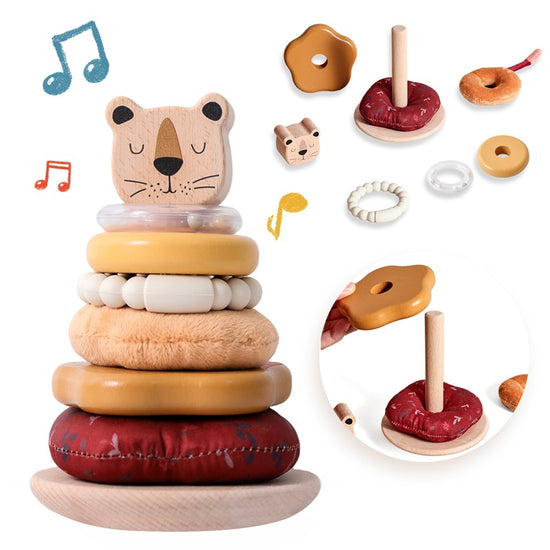
An 8-layer stacker with a built-in food-grade silicone teething ring, plus wood, fabric, and plastic pieces. Large, toddler-safe sizing with a weighted base so a baby can grab, chew, and stack on their own.
As with any teether or toy, keep an eye on your baby while they play, wash the silicone ring often, and check every piece now and then for wear.
Common Mistakes and Misconceptions About The Best Teething Toys for Babies
A few myths come up again and again in conversations with parents.
- "Freezing gives better relief." Cold helps, but frozen-solid teethers are often too hard and can be uncomfortable on sore gum tissue.
- "Amber necklaces work." There is no solid evidence behind this, and the choking and strangulation risks are well documented.
- "Teething causes high fever." A mild temperature rise can happen, but a true fever alongside other symptoms usually points to something else. It is worth checking with your pediatrician rather than assuming it is teeth.
- "Any cute teether is fine." Multi-piece toys, liquid-filled teethers, and pull-string designs are exactly the ones to skip, regardless of how appealing they look.
A Simple Step-by-Step Way to Choose a Teether for Babies
Here is a simple process that covers the basics from picking a teether to using it day to day.
Check the material
Look for a clear label: food-grade silicone, natural rubber, or untreated wood, and confirm it is BPA-free.
Confirm one-piece construction
Give it a gentle tug. If any part comes loose or separates, choose a different one.
Check the size
It should be too large to fit entirely inside your baby's mouth.
Match it to your baby's stage
A mitten or thin ring for early mouthers, a pronged teether for the front-tooth stage, and multi-texture toys as coordination grows.
Chill, don't freeze
A short stint in the fridge gives a mild, soothing cool without making the teether too hard.
Clean it before and after use
Wash with warm, soapy water and pick designs without deep crevices that are hard to reach.
Stay close while your baby uses it
Supervision is one of the simplest and most reliable safety habits you can build into playtime.
Signs of Teething vs Signs to Watch
Every baby is different, but a few general patterns can help you tell teething discomfort from something that may need a closer look.
| Often Just Teething | Worth a Call to Your Pediatrician |
|---|---|
| Heavy drooling and chewing on hands or toys | A fever of 100.4°F or higher |
| Mild fussiness, worse in the late afternoon | Ongoing diarrhea or vomiting |
| Slightly swollen or reddened gums | Unusual lethargy or refusing feeds |
| A short stretch of disrupted sleep | A rash that spreads beyond the chin or mouth |
Gum relief now, sensory play for months
The Alppi Lion Stacking Tower pairs a food-grade silicone teething ring with seven more textures to explore. Pair it with Alppi's gentle wipes to keep drool cleanup simple too.
Shop the Lion Stacking TowerKeep Reading:
Frequently Asked Questions
What is the best teething toy for babies?
What is the best thing to give a baby for teething?
What kind of teether is generally recommended?
What should I avoid when choosing a teether?
What are the hardest months for teething?
Final Thoughts
The best teething toys for babies are not complicated. Look for one-piece construction, safe materials, a size too big to swallow, and a shape that is easy to keep clean.
Chill instead of freezing, skip the categories with known safety warnings, and keep an eye on your baby while they play.
Get those basics right and you have covered nearly everything that matters.
Related Collections:


