


The best educational toys for toddlers aren't the ones that light up, talk, or sing. They are open-ended toys that put your toddler in charge: blocks, stackers, shape sorters, and multi-activity boards a child can return to again and again.
Here's a detail most toy aisles won't mention: several studies suggest toddlers talk less during electronic toy play than during play with simple, traditional toys.
The educational toys that earn daily play are rarely the flashiest. They're the simple ones that make the child do the thinking, which is where learning tends to happen.
- The best educational toys for toddlers are open-ended and screen-free, supporting problem-solving, language, and focus.
- Several studies found toddlers produce fewer words and less varied language during electronic toy play compared to traditional toy play.
- Stacking, sorting, threading, and fitting toys build fine motor skills, an early foundation for writing.
- Keep about 4 to 8 toys out at once and rotate the rest. Fewer toys tends to mean deeper focus.
- For 18-month-olds, the fundamentals cover most of it: blocks, a shape sorter, stacking rings, and a simple cause-and-effect toy.
What Counts as an Educational Toy for a Toddler?

An educational toy for a toddler is one that builds a specific skill, fine motor, language, or early problem-solving, through hands-on, open-ended play.
The defining feature isn't a "learning" label on the box. It's whether the toy lets the child lead.
The strongest categories for the toddler years:
-
Blocks — the original open-ended toy, building stacking, balance, counting, and spatial reasoning.
-
Stacking and nesting toys — refining grasp, sequencing, and size awareness.
-
Shape sorters — match-and-fit play that builds shape recognition and problem-solving.
-
Bead mazes, threading, and gear toys — developing the pincer grasp and hand-eye coordination.
-
Multi-activity wooden toys — busy boards or activity cubes that combine several skills in one.
-
Simple STEM toys — magnetic tiles, ramps, and sorting sets that introduce cause and effect.
If you're putting together a calm play space to go with these, our guide to sensory play for toddlers pairs well with an educational-toy shelf.
What makes a toy genuinely "educational"?
- It's open-ended. More than one "right" way to play means the toy keeps developing your child as their skills grow.
- It builds a real skill. Sorting builds shape recognition, stacking builds coordination, threading builds the pincer grasp.
- It invites interaction, not passive watching. The best toys spark back-and-forth talk instead of entertaining a toddler solo.
The Best Educational Toys for Toddlers by Skill

Instead of a random shopping list, here is a simple way to organize a shelf around what your toddler is actually developing.
| Skill Area | Toy Type | What It Builds |
|---|---|---|
| Fine motor | Stacking rings, nesting cups, shape sorters | Grasp, sequencing, and problem-solving precision |
| Fine motor | Bead mazes and threading toys | The pincer grasp, an early foundation for holding a pencil |
| Language and cognition | Realistic figurines and picture books | Vocabulary as your toddler names real things |
| Language and cognition | Open-ended pretend toys | Narration and back-and-forth conversation |
| Early STEM thinking | Wooden blocks | Balance, counting, and early spatial reasoning |
| Early STEM thinking | Ball-drop ramps and gear toys | Sequence, motion, and simple prediction |
Quick tip
When comparing two toys, ask which one leaves more room for you to talk with your toddler. The quieter option often wins on both language and focus.
Two Educational Toys That Grow With Your Toddler
A common frustration is a toddler dropping a new toy after two minutes. Simple, open-ended toys tend to hold interest longer because they keep offering new challenges.
Here are two battery-free educational toys from Alppi Baby pieces built around that idea, so your toddler does the talking and the thinking.

Eight ways to play in one solid wooden bus, including a xylophone, spinning gears, an animal shape sorter, and a bead maze. No batteries, so the toddler leads the play.
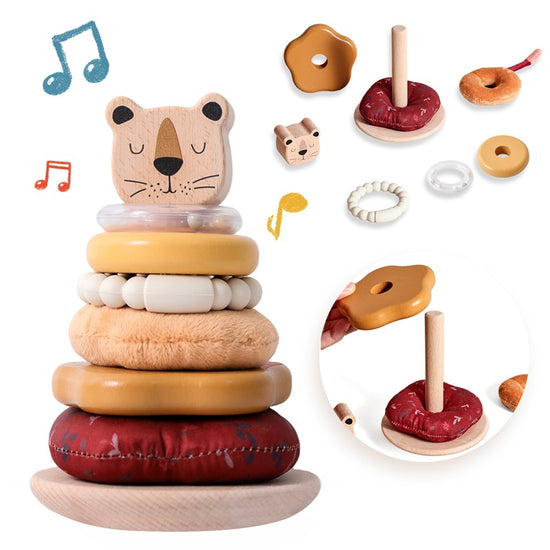
Eight distinct layers across wood, silicone, and fabric, with a weighted base and a wobble lion on top that teaches cause and effect through curious pushes.
Together, the Lion Stacking Tower tends to meet younger toddlers at the grasping-and-stacking stage, while the Activity Bus can carry them through toward age four.
As with any toy, keep an eye on play and check pieces for wear now and then.
Common Mistakes and Misconceptions About The Best Educational Toys
- "More features means more learning." Often the opposite. A toy your child keeps returning to tends to beat one that plays itself.
- "Electronic learning toys teach better." Several studies suggest they can reduce how much a toddler talks during play. A quieter toy leaves more room for conversation.
- "A toddler needs lots of toys to stay stimulated." A crammed shelf can overwhelm a toddler and work against concentration. Fewer toys, rotated regularly, tends to work better.
- "Educational means expensive." A simple set of blocks can outperform a pricier gadget. Judge a toy by its design and openness, not its marketing.
- "More help means faster learning." When a toddler struggles to fit a shape, resist stepping in right away. That struggle is often where the learning happens.
A Step-by-Step Way to Choose and Use Educational Toys

Here is a simple process for building and running a toddler-friendly toy shelf.
Observe your child first
Notice if they're stacking, posting things into gaps, threading, or narrating, and buy toward the skill they're already drawn to.
Pick open-ended over single-function
A toy with more than one right way to play tends to last longer developmentally.
Favor battery-free
Quieter toys tend to invite more talk and deeper focus than toys that light up or play sounds.
Set up a low, accessible shelf
Toys at eye level, one per spot, with space around each so your toddler can choose and concentrate.
Keep only 4 to 8 toys out
Store the rest and rotate the selection every week or two.
Demonstrate slowly, then step back
Show the purpose once with calm hands, then let your child explore on their own.
Add language as they play
Name what they build, towers, animals, colors, to fold vocabulary naturally into playtime.
Educational Toys by Age: A Quick Reference
Toy needs shift through the toddler years. Here is a simple guide to what tends to fit each stage.
| Age Range | Typical Focus | Good Toy Types |
|---|---|---|
| 12 to 18 months | Grasping, stacking, early cause and effect | Stacking rings, nesting cups, simple posting toys |
| 18 to 24 months | Fitting shapes, naming objects, short phrases | Shape sorters, wooden blocks, picture books |
| 2 to 3 years | Pretend play, simple problem-solving | Bead mazes, magnetic tiles, open-ended pretend sets |
Build a calm, screen-free play shelf that lasts
The Animal Activity Bus and the Lion Stacking Tower are two non-toxic educational toys designed to grow with your child, alongside the rest of Alppi's baby essentials.
Shop educational toysKeep Reading
Frequently Asked Questions
How many toys should a toddler have out at once?
Which toys are best for developing a toddler's fine motor skills?
Do electronic toys affect toddler talk?
What toys do 18-month-olds actually need?
What are good STEM toys for toddlers?
Final Thoughts
The best educational toys for toddlers are open-ended, battery-free, and built to grow with your child, since a toy that keeps offering new challenges tends to keep building skills.
Keep just a handful out at a time, rotate often, demonstrate slowly, and let your toddler do the work. Simple, traditional toys tend to protect the kind of active, talkative, child-led play that supports early development.
More Collections to Explore:


