


Choosing the best developmental toys for babies is less about finding the "perfect" toy and more about avoiding a handful of common, easy-to-miss mistakes.
After years of working with infants, the same five errors tend to show up again and again: the flashing toy, the toy that's too advanced, or a pile of ten toys when two would work better. Get past those traps and the right choices tend to become obvious.
Every one of these mistakes is easy to avoid once you know what to look for. Here are all five, one at a time.
- Mistake 1: Buying electronic toys that "play for" the baby. Several studies link these toys to less baby talk during play.
- Mistake 2: Overlooking choking hazards. Anything small enough to fit fully in the mouth is a risk for babies under 3.
- Mistake 3: Buying too many toys at once. A crammed shelf can work against focus. Keep a few out and rotate.
- Mistake 4: Picking toys that are too advanced or too basic for your baby's current stage.
- Mistake 5: Overlooking materials. For babies who mouth everything, non-toxic and choke-safe sizing matter.
What Actually Makes a Toy "Developmental"?

Before the mistakes, here is the idea that ties them all together: the best toys for babies tend to be open-ended, safe to mouth, and matched to your baby's current stage.
A good baby toy invites interaction, with you and with the world, rather than doing the playing for your child.
That single idea, letting the baby do the work, is why each mistake below tends to work against development. With that frame in place, here is what to watch for.
If you want to see what each stage actually looks like, our baby milestones by month guide pairs well with smart toy choices.
5 Buying Mistakes to Avoid When Buying Baby’s Toys
Here is a walk-through of the five mistakes that come up most often, along with a simple fix for each.
Buying electronic toys that "play for" the baby
The flashing, singing, button-covered toy looks impressive, but several studies suggest babies talk less and use fewer unique words during electronic toy play than during traditional toy play. Electronic toys often do the talking and imagining for the child, which can crowd out the responsive interaction that tends to support language. Many health authorities also suggest limiting screen time for children under 2.
The fix: favor simple, battery-free toys, blocks, stackers, rattles, and let your own voice be the soundtrack.
Overlooking choking hazards
"Sold for babies" does not always mean safe for every age. A common rule of thumb: any toy or part small enough to fit through a standard toilet paper tube is a choking risk for a baby under 3. For babies under 6 months especially, watch for small detachable parts, long strings or cords, button batteries, and liquid-filled teethers.
The fix: check size and construction before every purchase, and keep supervision as part of every play session.
Buying too many toys at once
More toys can feel like more stimulation, but in practice a crammed shelf tends to overwhelm a baby and reduce focus. A baby faced with a big pile often flits between toys without engaging deeply with any single one.
The fix: keep just a few toys out at a time, store the rest, and rotate every week or two.
Choosing toys that don't match the stage
This mistake cuts both ways. A newborn handed a shape sorter gets little from it, since their eyes typically focus best about 8 to 12 inches away. A nine-month-old given only a newborn rattle may be under-stimulated. The sweet spot is a toy slightly ahead of your baby's current skill, challenging but not frustrating.
The fix: buy for the stage your baby is in now, or just ahead, and favor toys that grow across several stages.
Overlooking materials and safety of finish
The final mistake is focusing on features while overlooking what a toy is made of, which matters for babies who mouth everything. Many plastic toys can break into sharp pieces, and researchers have flagged concerns about certain chemicals used in some plastic toys. Well-made wooden and food-grade silicone toys tend not to splinter the same way.
The fix: prioritize natural wood, food-grade silicone, and water-based non-toxic paint, especially for anything destined for the mouth.
Quick tip
A simple check before buying: try to pass the toy or its smallest part through a toilet paper tube. If it fits, it is not right for a baby under 3, regardless of what the packaging says.
A Quick Stage Map for the First Three Years
Toy needs shift fast in the early years. Here is a simple reference for what tends to fit each stage.
| Age Range | Typical Focus | Good Toy Types |
|---|---|---|
| Newborn to 2 months | Visual tracking, high-contrast patterns | High-contrast cards, books, simple mobiles |
| 3 to 4 months | Grasping and reaching | Lightweight, easy-grip rattles and rings |
| 5 to 6 months | Mouthing, cause and effect | Textured balls, soft squeeze toys, safe teethers |
| 7 to 12 months | Movement, problem-solving | Rolling toys, nesting and put-in-take-out toys, stackers |
| 1 to 3 years | Fine motor, early STEM thinking | Open-ended stacking, sorting, multi-activity toys |
Materials: What to Favor and What to Skip
Since babies mouth almost everything, material choice matters as much as the toy's design.
Here is a quick side-by-side.
| Tends to Work Well | Worth a Second Look |
|---|---|
| Natural wood with water-based, non-toxic paint | Painted toys without a clear non-toxic label |
| Food-grade or medical-grade silicone | Liquid or gel-filled teethers |
| One-piece construction with smooth edges | Multi-piece toys with small detachable parts |
| Toys clearly labeled BPA-, PVC-, and phthalate-free | Toys with no material or safety labeling at all |
Three Best Developmental Toys That Avoid All Five Mistakes
Once you apply the five rules, the toys that tend to hold up share the same traits: open-ended, non-toxic, choke-safe, stage-matched, and battery-free.
Here are three Alppi options built with that in mind, each designed to grow with your child rather than be outgrown in a month.
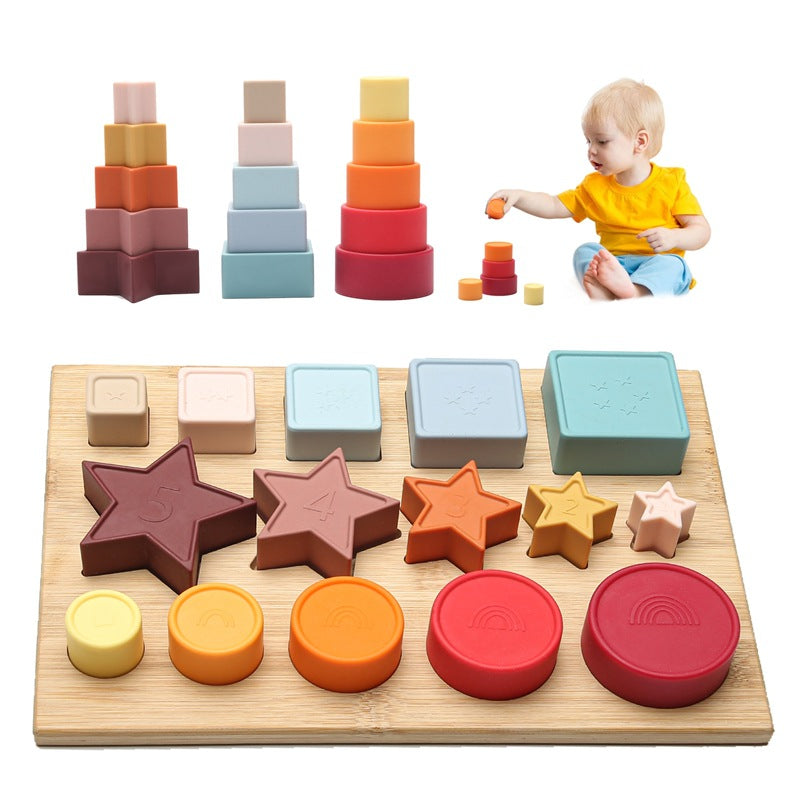
Eight shapes in soft, food-grade silicone with several play modes: stack by size, sort by shape, nest smallest to largest, or balance into towers.
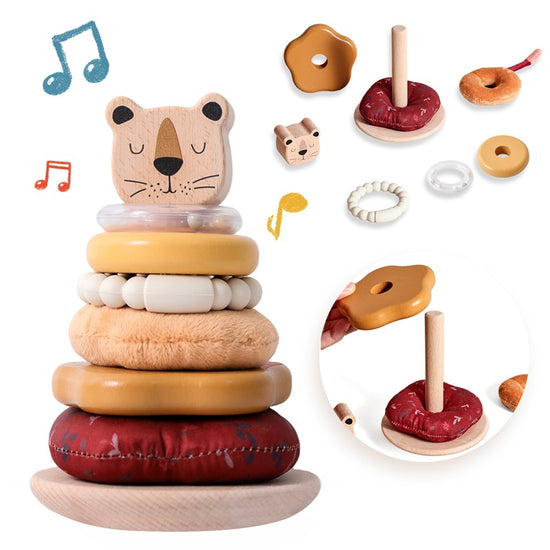
Eight distinct layers across wood, silicone, and fabric, with a built-in food-grade silicone ring for safe chewing and a weighted base for independent play.

Eight ways to play in one solid wooden bus, including a xylophone, spinning gears, and an animal shape sorter. No batteries, so the baby leads the play.
As with any toy, keep an eye on play and check pieces for wear now and then.
A quick safety checklist
- No small detachable parts. If anything can break off with a gentle tug, it is not right for a mouthing baby.
- No long strings or cords. These can pose a strangulation or choking risk.
- No button batteries. These carry serious risks if swallowed and should stay out of reach.
- No liquid or gel-filled teethers. These can rupture if bitten hard enough.
- Supervision, every time. No safety feature replaces watching your baby during play.
A Simple Guide to Picking the Right Toy
Skip the batteries
Look for passive toys that wait for your baby to make the first move, so their brain stays engaged rather than watching.
Put safety first
Check for loose parts, long strings, or small button batteries. If an item fits through a toilet paper tube, it is too small.
Buy for right now, or just a little ahead
A toy far beyond your baby's skill level tends to cause frustration. Look for flexible toys that can grow with them.
Keep it minimal
Leave out just a handful of toys at a time and rotate the rest every week or two to keep things feeling fresh.
Check what it's made of
Stick to natural wood, organic fabrics, and food-grade silicone to keep playtime non-toxic for a baby who mouths everything.
Choose toys that get all five right
The Montessori Natural Learning Stack, the Lion Stacking Tower, and the Animal Activity Bus are three non-toxic, battery-free toys designed to grow with your child.
Shop developmental toysKeep Reading
Frequently Asked Questions
What is the biggest mistake parents make when buying baby toys?
How do I know if a baby toy is a choking hazard?
How many toys should a baby have out at once?
Are wooden and silicone toys really better than plastic for babies?
What toys actually help a baby's development?
Final Thoughts
The best toys for babies are not found by chasing features. They come from avoiding five mistakes: skip the electronic toys that play for your baby, rule out choking hazards, resist buying a pile of toys at once, match the toy to your baby's actual stage, and read the materials.
Apply those five rules and the right toys, open-ended, non-toxic, and built to grow, tend to become easy to spot.
Related Collections to Explore:


