


A newborn sleep schedule is less about strict clock times and more about understanding your baby's natural rhythms. In the early weeks, sleep comes in short bursts around the clock — and that's completely normal.
If you're wondering what a realistic newborn sleep schedule looks like hour by hour, you're not alone. Most new parents expect longer stretches sooner than they actually arrive.
\This guide breaks down how much sleep your newborn needs at every stage, what wake windows to aim for, sample schedules from birth to 12 months, and safe sleep practices backed by pediatric guidelines.
- Newborns sleep 14 to 17 hours a day in short 1- to 3-hour stretches throughout the day and night.
- A consistent newborn sleep schedule starts forming around 3 to 4 months as circadian rhythms develop.
- Wake windows — the time baby can comfortably stay awake — grow from 45 minutes at birth to 3 to 4 hours by 12 months.
- Safe sleep basics (back sleeping, firm surface, bare crib) apply at every stage and every nap.
- Nighttime dryness from a reliable diaper helps reduce unnecessary wake-ups caused by leaks or discomfort.
How Much Sleep Does a Newborn Need?

Newborns typically need 14 to 17 hours of sleep in a 24-hour period, according to the National Sleep Foundation. But that sleep doesn't come in one long block — it arrives in short fragments of 1 to 3 hours, spread across day and night with no clear pattern at first.
Your baby doesn't yet have a developed circadian rhythm — the internal clock that tells adults when to sleep and when to be awake. That clock starts forming around 6 to 8 weeks and becomes more established by 3 to 4 months. Until then, your newborn sleep schedule will feel unpredictable, and that's biologically normal.
Newborn Sleep Schedule by Age
Sleep needs change quickly in the first year. Here's a research-backed breakdown of what to expect at each stage.
| Age | Total Sleep (24 hrs) | Wake Windows | Naps Per Day | Nighttime Sleep |
|---|---|---|---|---|
| 0–6 weeks | 14–17 hours | 45–60 minutes | 6–8 naps | 8–9 hours (fragmented) |
| 6–12 weeks | 14–17 hours | 60–90 minutes | 4–6 naps | 8–10 hours (waking to feed) |
| 3–4 months | 14–16 hours | 75–120 minutes | 3–4 naps | 10–11 hours (1–2 feeds) |
| 5–7 months | 12–15 hours | 2–3 hours | 2–3 naps | 10–12 hours |
| 8–12 months | 12–14 hours | 2.5–4 hours | 2 naps | 11–12 hours |
These are general ranges — every baby is different. If your baby's sleep falls slightly outside these ranges but they seem well-rested and are gaining weight normally, there's usually no cause for concern. Always check with your pediatrician if you're worried about your baby's sleep patterns or overall development. For a broader picture of what's happening at each stage, our baby milestones by month guide is a helpful companion.
What Are Wake Windows?
Wake windows are the stretches of time your baby can comfortably stay awake between naps. Keeping baby up too long leads to overtiredness, which actually makes it harder to fall asleep. Watch for sleepy cues like yawning, eye rubbing, or turning away from stimulation — those are your signal to start winding down.
Sample Newborn Sleep Schedule: Hour by Hour
A strict minute-by-minute schedule isn't realistic for newborns — their stomachs are tiny and they need to eat frequently. But having a general rhythm to aim for can help structure your day. Here are sample routines for three key stages.
Newborn (0–8 Weeks) Sample Day
At this stage, your baby eats, sleeps, and repeats in short cycles of roughly 2 to 3 hours. Breastfed newborns typically feed every 2 to 3 hours, while formula-fed babies may go 3 to 4 hours between feeds. Bedtime is usually late — around 9 to 10 p.m. — to match your baby's natural rhythm.
| Time | Activity |
|---|---|
| 7:00 AM | Wake, feed, brief alert time (15–30 min) |
| 7:45 AM | Nap 1 (1.5–2 hours) |
| 9:30 AM | Wake, feed, tummy time or gentle play |
| 10:15 AM | Nap 2 (1.5–2 hours) |
| 12:00 PM | Wake, feed, short interaction |
| 12:45 PM | Nap 3 (1.5–2 hours) |
| 2:30 PM | Wake, feed, alert time |
| 3:15 PM | Nap 4 (1–2 hours) |
| 5:00 PM | Wake, feed, cluster feeding may begin |
| 6:00 PM | Catnap (30–60 min) |
| 7:00 PM | Wake, feed, fussy period common |
| 8:00 PM | Catnap (30–45 min) |
| 9:30 PM | Final feed, diaper change, bedtime routine, down for "night" |
| Overnight | Wake every 2–3 hours to feed (breastfed) or 3–4 hours (formula-fed) |
Don't stress if your day doesn't look exactly like this. At this age, following your baby's hunger and sleep cues matters far more than the clock. For more on caring for your newborn during this stage, see our guides on how to hold a newborn and newborn essentials.
3–4 Months: When a Schedule Starts Forming
By 3 to 4 months, your baby's internal clock is maturing. You may notice a more predictable bedtime emerging — usually between 7 and 8 p.m. — and longer nighttime stretches of 4 to 6 hours. Many babies drop to 3 or 4 naps during the day. This is also when the 3-month milestones start appearing, which can temporarily disrupt sleep.
6–12 Months: A Settled Newborn Sleep Schedule
By 6 months, about two-thirds of babies can sleep 6 to 8 consecutive hours at night. Most are on a 2- to 3-nap schedule during the day, dropping to 2 naps by 8 to 9 months. Bedtime is typically between 6:30 and 7:30 p.m., with total nighttime sleep around 11 to 12 hours.
Keep in mind that 6-month milestones like sitting, babbling, and starting solids can all temporarily affect sleep. If your baby suddenly starts waking more around this age, a sleep regression may be at play — we cover those in detail in our guides on the 7-month sleep regression and 10-month sleep regression.
Safe Sleep Practices for Every Newborn Sleep Schedule
No matter what schedule your baby follows, safe sleep guidelines from the American Academy of Pediatrics (AAP) should be the foundation. These apply to every nap and every night.
- Always place baby on their back to sleep — for naps and nighttime. Back sleeping is the single biggest protective factor against SIDS.
- Use a firm, flat sleep surface — a crib, bassinet, or play yard with a tight-fitting sheet and nothing else in it.
- Keep the crib bare — no blankets, pillows, bumper pads, stuffed animals, or loose bedding until at least 12 months.
- Room-share without bed-sharing — the AAP recommends keeping baby's sleep space in your room for at least the first 6 months.
- Avoid overheating — dress baby in one layer more than you'd wear. Watch for sweating or feeling hot to the touch.
- Offer a pacifier at sleep time — research suggests pacifier use at naps and bedtime reduces SIDS risk.
Safety Reminders from the AAP
- Never use weighted swaddles, weighted sleep sacks, or weighted blankets for infants.
- Don't rely on cardiorespiratory monitors or devices that claim to reduce SIDS risk — there's no evidence they work.
- Avoid inclined sleepers, sleep positioners, or pillows of any kind.
- Never let a newborn under 3 months go too long between feeds without pediatrician approval.
For more on how Alppi Baby's safety standards align with pediatric guidelines, visit our safety and certifications page.
Tips for Building a Healthy Newborn Sleep Schedule
Teach Day from Night Early
During the day, keep the house bright and active. At night, use dim lights, speak quietly, and keep interactions short — even during feeds and diaper changes. This helps your baby's circadian rhythm develop faster.
Watch for Sleepy Cues, Not the Clock
Yawning, eye rubbing, turning away, fussiness — these are your baby telling you they're tired. Putting baby down at the first signs of drowsiness (but before they're overtired) leads to easier, longer sleep.
Start a Simple Bedtime Routine by 6–8 Weeks
A short, consistent routine — bath, feed, book or song, lights out — signals to your baby that sleep is coming. It doesn't need to be long. Even 15 to 20 minutes makes a difference when repeated consistently.
Put Baby Down Drowsy But Awake
When you can, place your baby in their crib while they're drowsy but still awake. This helps them learn to fall asleep independently — a skill that pays off when they wake between sleep cycles at night.
Use a Reliable Overnight Diaper
A diaper that leaks at 2 a.m. turns a normal sleep cycle transition into a full wake-up. Using an overnight diaper with strong absorbency — like Alppi's Wispy Cloud Diapers — keeps your baby dry and comfortable through longer stretches.
Sleep Regressions That Disrupt a Newborn Sleep Schedule
Just when you think you've cracked the code, a sleep regression can throw everything off. Regressions are temporary periods when a baby who was sleeping well suddenly starts waking more, fighting naps, or having trouble settling. They're typically triggered by developmental leaps, not by anything you're doing wrong.
| Regression | Typical Timing | Main Trigger | Duration |
|---|---|---|---|
| 4-month regression | 3–5 months | Permanent change in sleep architecture | 2–6 weeks |
| 6-month regression | 5–7 months | Motor milestones, starting solids, teething | A few days to 6 weeks |
| 8-month regression | 8–10 months | Crawling, separation anxiety, nap transition | 2–6 weeks |
The 4-month regression is the most significant because it involves a permanent shift in how your baby cycles through sleep stages. After this point, babies sleep more like adults — cycling through light and deep sleep — which can cause more wake-ups between cycles.
For detailed guidance on each, check out our articles on the 7-month sleep regression and 10-month sleep regression. And if teething is disrupting sleep too, we have a guide for that as well.
Overnight Comfort for Better Sleep
A baby who wakes up because of a leaky diaper or uncomfortable wetness isn't getting the rest they need — and neither are you. Alppi Baby diapers are designed with 3x absorbency and breathable materials to keep your baby dry and comfortable through even the longest overnight stretches. Every diaper is hypoallergenic, dermatologist-tested, and made in FDA-registered facilities.

Wispy Cloud Diaper Monthly Box
Cloud-soft overnight protection with 3x absorbency. A full month of diapers delivered to your door.
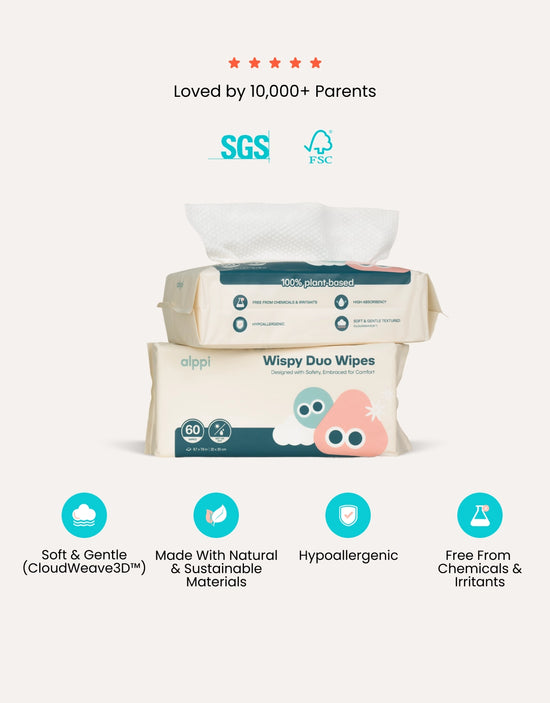
Wispy Duo Wipes (Dry)
Hypoallergenic, alcohol-free wipes perfect for quick, gentle nighttime diaper changes.
Not sure which diaper size your baby needs? Check the Alppi Baby sizing guide or browse the full baby diapers collection. For ongoing supply, a diaper subscription keeps you stocked without the last-minute runs.
Conclusion: Building a Newborn Sleep Schedule That Works
A newborn sleep schedule isn't something you enforce — it's something you build gradually by responding to your baby's cues, keeping routines consistent, and creating a safe, comfortable sleep environment. The first few months are unpredictable by design. Your baby's brain and body are still developing the internal clock that will eventually make longer stretches possible.
Focus on what you can control: a calm bedtime routine, safe sleep practices, reliable overnight protection, and patience. The rest will follow as your baby grows. If you're concerned about your baby's sleep at any point, always talk to your pediatrician — they can rule out any underlying issues and provide guidance tailored to your child.
Keep Baby Dry Through the Night
Leak-free nights mean better sleep for everyone. Alppi Baby diapers are built for overnight comfort with 3x absorbency, breathable materials, and cloud-soft feel.
Shop Diapers


